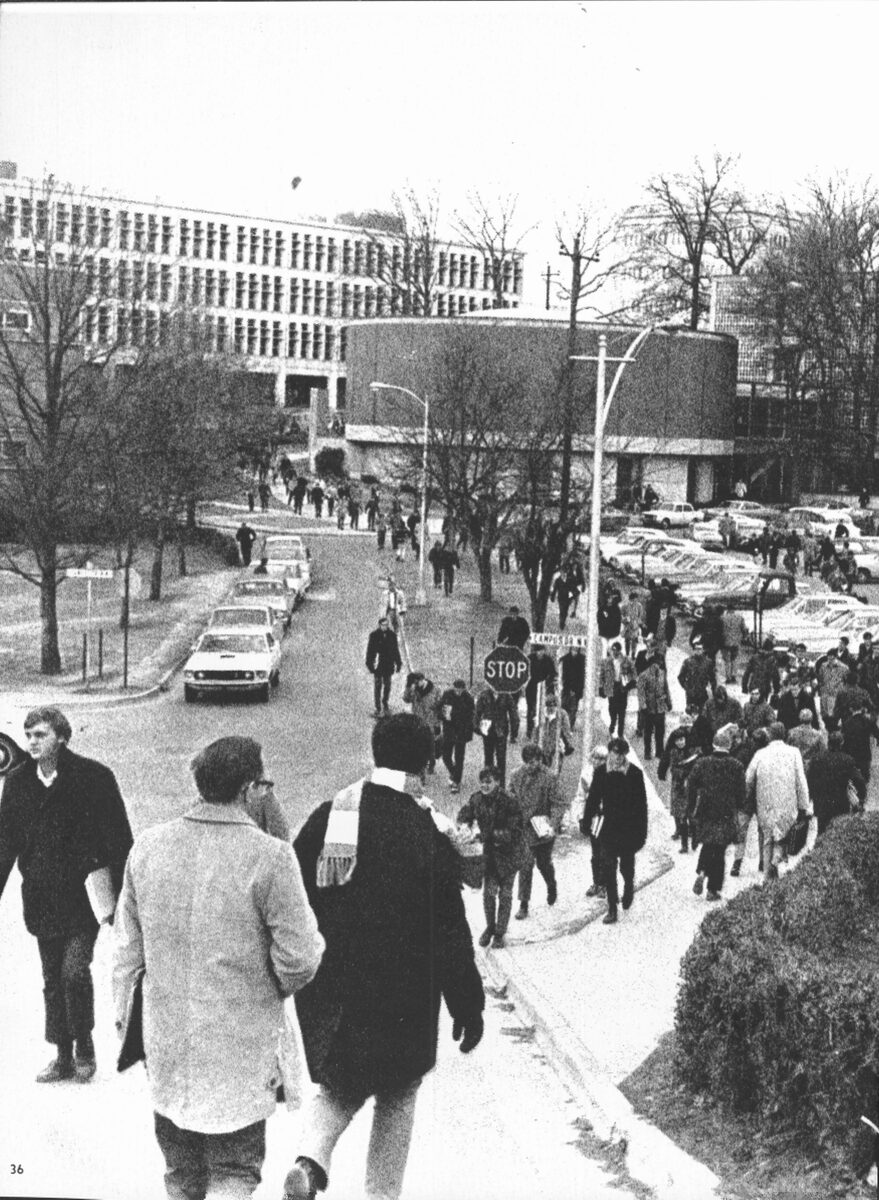
Georgia Tech campus, circa 1970

Georgia Tech Archives · 1920–1970

Brothers in Heart

A Half-Century of International Students at Georgia Tech
Site by Harvey

Corda Fratres — Latin: "Brothers in Heart"
Scroll to explore

01

A Story in Three Acts

The first international student appeared in Georgia Tech documents in 1919 Latin American Club, and by 1920, the Club had evolved into the Cosmopolitan Club, which marks Georgia Tech's involvement in a larger global movement of international student organizations.

Between 1920 and 1970, international student support at Georgia Tech evolved through three distinct phases: from a student-led club to a formal administrative office. This is the story of how a small group of students seeking connection across borders built something that would endure for half a century.

Phase 1 Club-Based Organization 1920–1940s
Phase 2 Programmatic Funding 1947–1960s
Phase 3 Administrative Institutionalization 1960s–1970

02

A Movement Born in Turin

Corda Fratres & the Association of Cosmopolitan Clubs, 1898–1920

1898

In Turin, Italy, Ephraim (Efisio) Giglio-Tos founded the International Federation of Students, known by its Latin name Corda Fratres—"Brothers in Heart." Emerging from the festive and carnival societies of European universities, the organization was dedicated to fostering international friendship and opposing war through cultural activities and fundraising.

Corda Fratres quickly expanded from its European base to include chapters in Australia, Brazil, Egypt, Chile, Malta, India, China, and the United States, maintaining "particularly strong connections with the United States, where similar student organizations were active" (Global Student Forum).

Founding city Chapter / affiliate U.S. Cosmopolitan Clubs

Drag to explore · Corda Fratres chapters worldwide, c. 1907–1920

8
International Congresses
held before WWI
10+
Countries with
Corda Fratres chapters
1907
Association of Cosmopolitan
Clubs founded in the U.S.
"From its founding, Corda Fratres faced leadership disputes between Italy and France, and divisions among Jewish students split between pro- and anti-Zionist factions. These political and religious tensions frequently disrupted conferences."

The organization also struggled with fundamental questions about funding, legitimacy, and independence—who would provide resources, who would represent each country, and how to maintain autonomy while potentially criticizing home governments. In 1909, the Association of Cosmopolitan Clubs formally merged with Corda Fratres as its American branch, bringing its university-chapter structure under the international umbrella.

03

The Cosmopolitan Club

Georgia Tech's First International Student Organization, 1920–1940s

Dec 10 1920

A Club Is Born

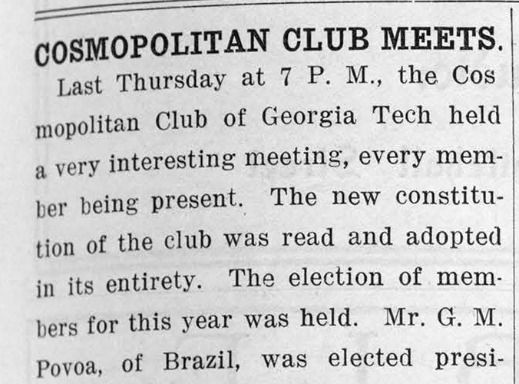
The Technique reported a formal meeting of the Cosmopolitan Club, with officers elected from multiple countries and an application submitted for a Corda Fratres charter. Later that month, Georgia Tech delegates traveled to Ann Arbor, Michigan for the Corda Fratres convention.

Technique, December 10, 1920 - Cosmopolitan Club meeting report
The Technique, Dec. 10, 1920 — "Cosmopolitan Club Meets"
Mar 18 1921

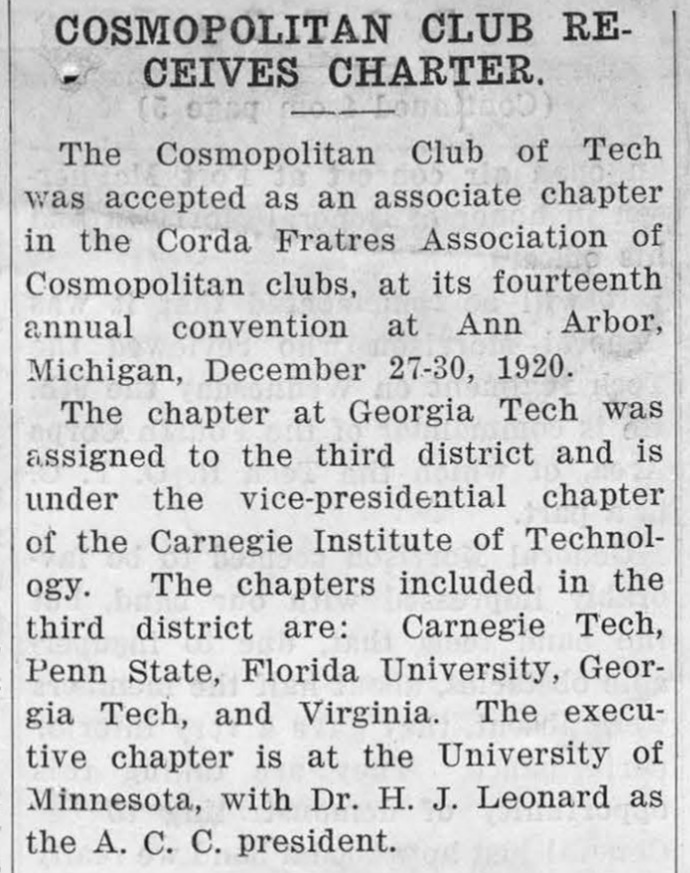
Associate Chapter Accepted

Georgia Tech's chapter was formally accepted as an associate chapter of Corda Fratres at the convention in Ann Arbor, connecting the school to a worldwide network of international student friendship that stretched from Turin to Atlanta.

Technique, March 18, 1921 - Charter acceptance
The Technique, Mar. 18, 1921
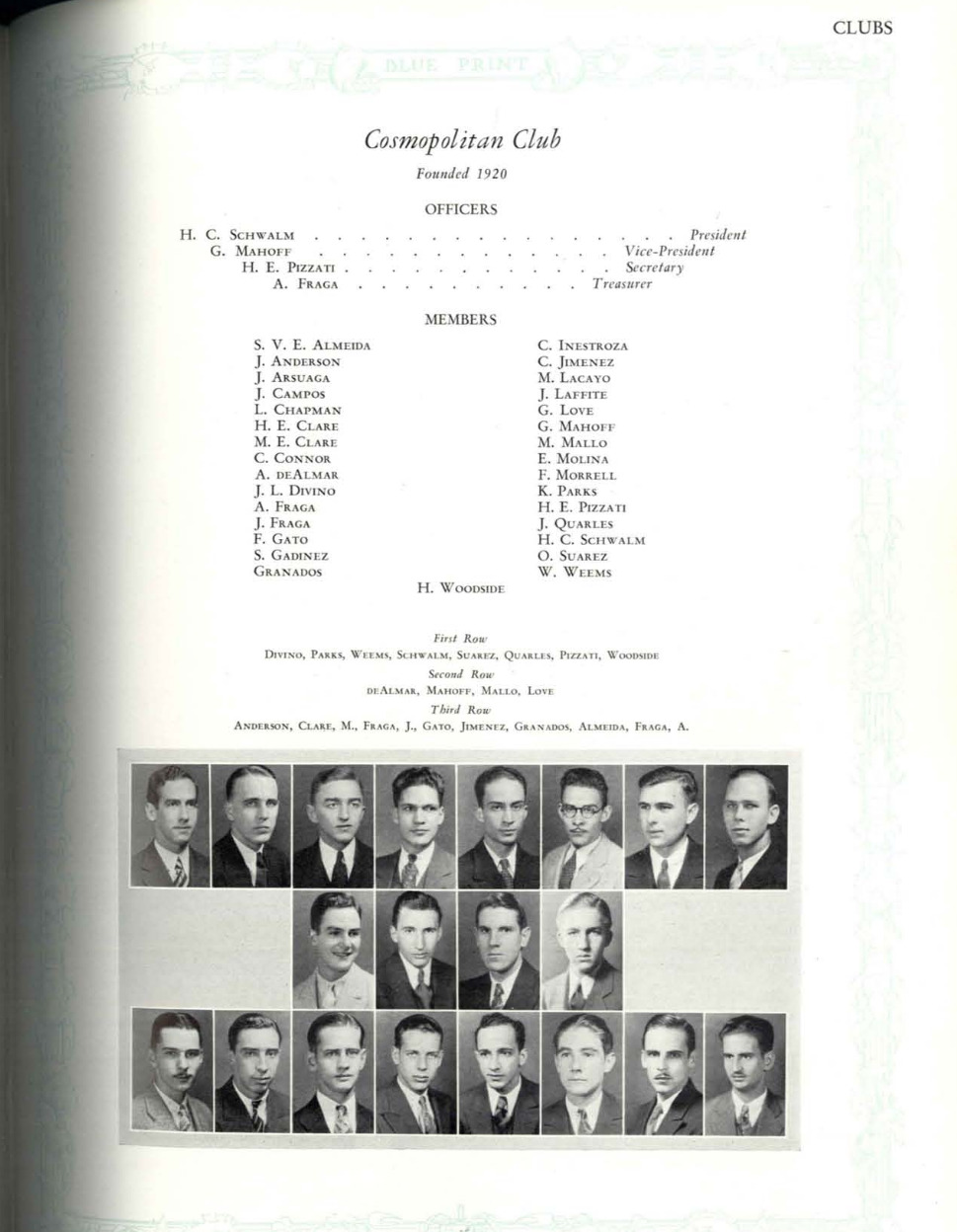
BluePrint 1933 - Cosmopolitan Club, Founded 1920
Blue Print, 1933 — "Cosmopolitan Club … Founded 1920"
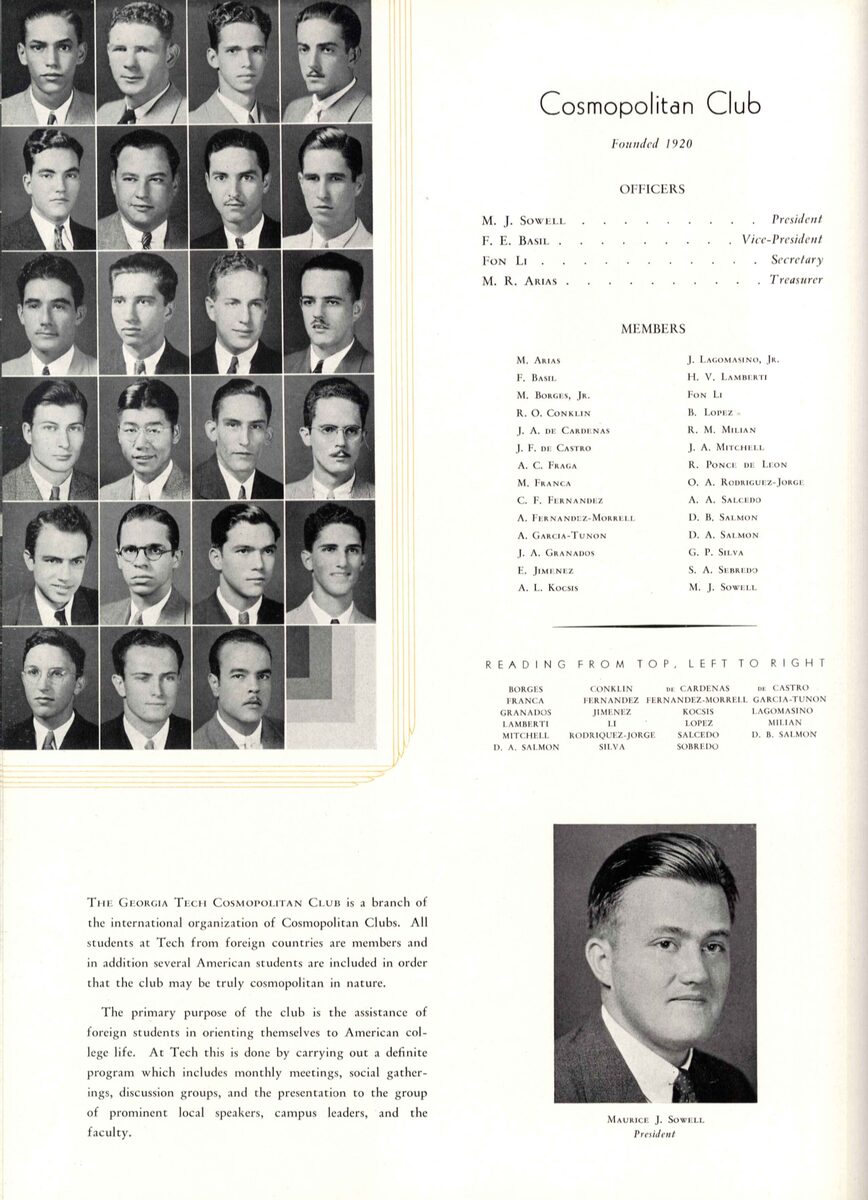
BluePrint 1936 - Cosmopolitan Club page with officers and members
Blue Print, 1936 — Officers, members, and group photographs

The Blue Print yearbook consistently documented the Cosmopolitan Club with officer rosters and country-diverse membership lists, marking it as a durable annual organization rather than a one-off social group. The 1936 page describes its mission:

"The Georgia Tech Cosmopolitan Club is a branch of the international organization of Cosmopolitan Clubs. All students at Tech from foreign countries are members and in addition several American students are included in order that the club may be truly cosmopolitan in nature."

The club's primary purpose was "the assistance of foreign students in orienting themselves to American college life," accomplished through monthly meetings, social gatherings, discussion groups, and presentations by prominent speakers.

Expansion & Intercollegiate Cooperation

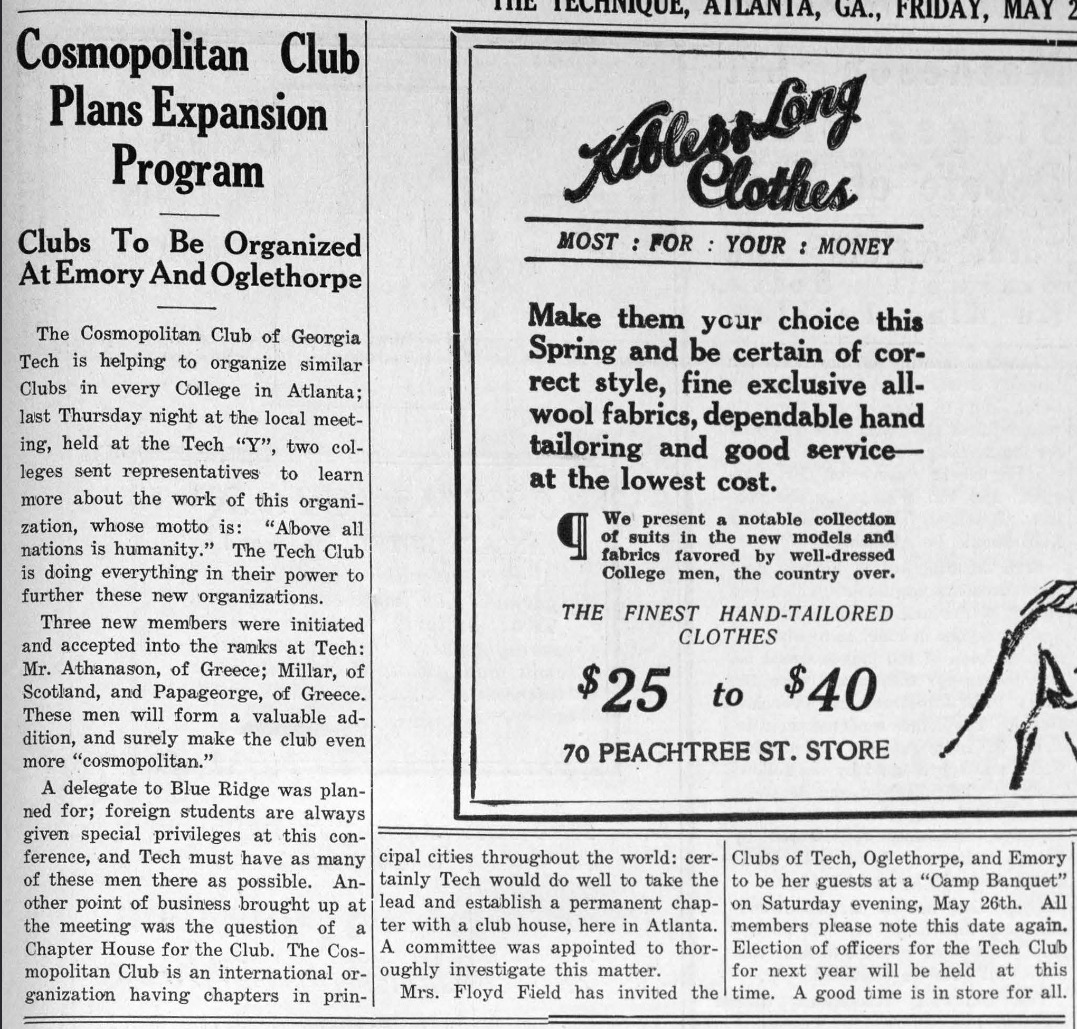
By 1923, the Technique reported the club "Plans Expansion Program," including intercollegiate organizing with other Atlanta institutions such as Emory and Oglethorpe. Bulletin descriptions in the late 1920s and 1930s presented a consistent mission of supporting foreign students and integrating selected American students.

Technique, 1923 - Cosmopolitan Club expansion plans
The Technique, May 25, 1923

The YMCA Connection

Multiple Bulletin editions explicitly state that "through YMCA cooperation, foreign students organized the Cosmopolitan Club," indicating the YMCA acted as an incubator and host structure for international student organization.

Georgia Tech YMCA Building

Dedicated June 7, 1912

  • 300-seat auditorium
  • Bowling alleys & billiard rooms
  • Offices for most student organizations
  • $50,000 donation from John D. Rockefeller
  • Total construction cost: $75,000
  • Now L. W. "Chip" Robert, Jr. Alumni House, renamed in 1979
1937–1940s

The last documented Cosmopolitan Club activity appears in a 1937 Technique article, "Cosmopolitan Club Plans Picnic." It is still unclear whether the club continued to operate during the late 1930s and early 1940s, but I suspect that the declination is due to World War II, which disrupted international student movements worldwide.

1947

Two years after the war's end, a new generation of veterans would reimagine international student support at Georgia Tech.

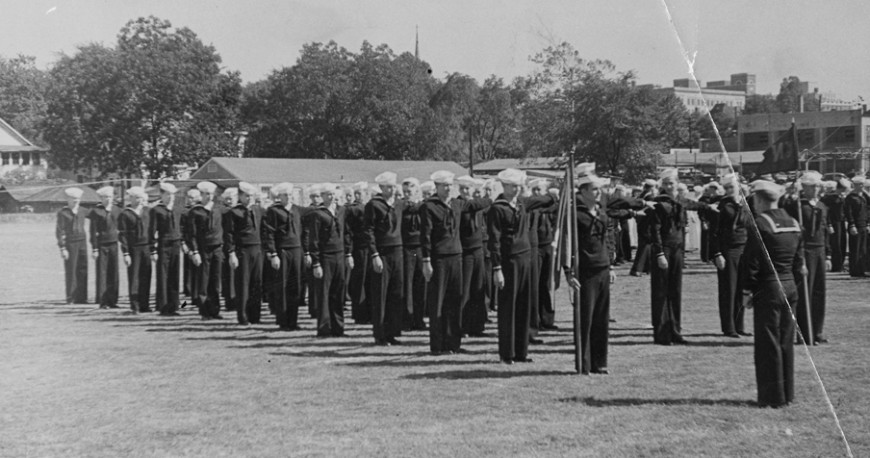
ROTC at Georgia Tech

04

World Student Fund

From Veterans' Peace Mission to Institutional Program, 1947–1970s

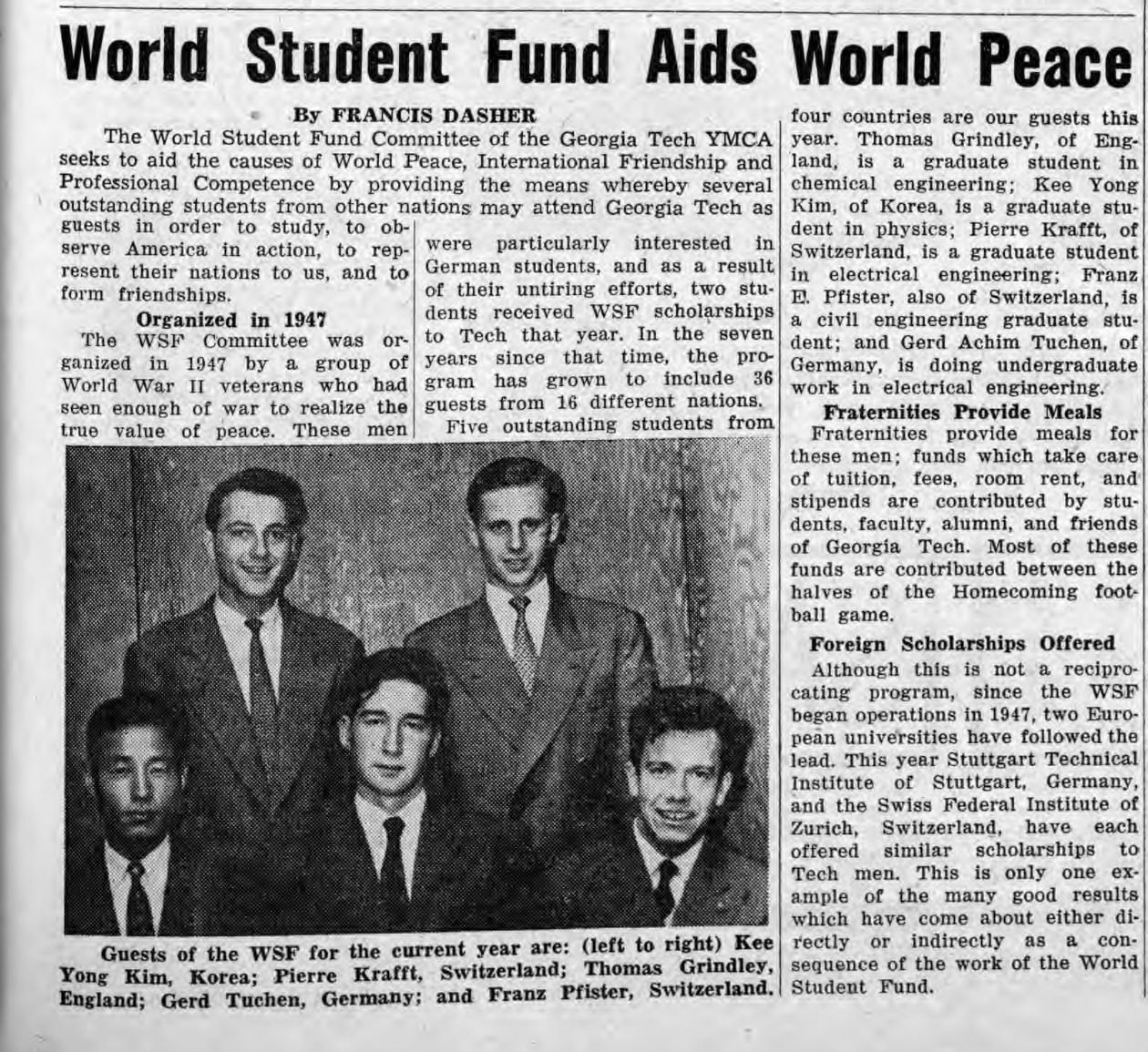
Technique, October 28, 1955 - World Student Fund Aids World Peace
The Technique, Oct. 28, 1955 — "World Student Fund Aids World Peace"
1947

The World Student Fund (WSF) Committee was organized by veterans at Georgia Tech, affiliated with the Georgia Tech YMCA. Its mission was explicit: world peace, international friendship, and professional development through hosting international students.

The timing was deliberate. Returning veterans, shaped by the devastation of global conflict, sought to build international understanding. The WSF represented a fundamentally different model from the pre-war Cosmopolitan Club—moving from voluntary membership to systematic fundraising and direct financial support.
YMCA: The constant support

1912

YMCA building dedicated on North Avenue. John D. Rockefeller donated $50,000. The building became the hub of campus social life, housing most student organizations.

1920s–30s

YMCA incubates the Cosmopolitan Club, providing meeting space and organizational support for international students.

1947–60s

WSF operates as a YMCA-affiliated committee. The YMCA also sponsors annual tours of the U.S.S.R. as part of international programming during the 1960s.

1970

Fred B. Wenn Student Center opens; student activities shift away from YMCA. YMCA focus narrows to international scholarship administration.

1973

YMCA moves off campus to All Saints Episcopal Church. The former YMCA building is later rededicated as the L. W. "Chip" Robert, Jr. Alumni/Faculty House (November 1979).

05

Institutionalization

From Peers to Professionals, 1960s–1970

By the 1960s, international student support at Georgia Tech underwent its final transformation—from volunteer-run programs to formal administrative structures. This shift mirrored broader patterns across American higher education: the growth of student services bureaucracies, the professionalization of student affairs, and the increasing complexity of international education.

1964–65
Student Governance

Bulletin records formally include International Students Representative positions in student governance and publications contexts.

1965–66
Named Representative

Henry Villa is listed as "International Students Representative." The Dean of Students office formally includes "international student affairs" among core functions.

1969–70
Professional Office

General Catalog staff listings include a dedicated "Assistant Dean of Students; International Student Advisor" title, marking full administrative integration.

Student Council 1963-1964

46 representatives across all classes, including Tibet Giray (★) as International Students Representative.

Parallel Systems

During the 1960s, two parallel channels coexisted: the YMCA-based World Student Fund continued its fundraising and scholarship operations, while formal administrative support developed independently through the Dean of Students office. The 1967 Bulletin still lists "World Student Fund" under "YMCA Groups" even as it separately records International Students Representative positions in governance contexts.

This dual structure persisted until the YMCA's departure from campus, after which international student support was fully absorbed into the university's administrative infrastructure.

06

Legacy

Continuities, Transformations, and Unanswered Questions

Three-Phase Evolution

1920–1940s
Club-Based
  • Model: Student-led voluntary organization
  • Support: YMCA
  • Activities: Social integration, peer support
  • Funding: Voluntary membership, institutional affiliation
  • End: WWII disruption
1947–1960s
Programmatic
  • Model: Committee-based fundraising
  • Support: YMCA
  • Activities: Direct financial support, exchanges
  • Funding: Systematic campus-wide campaigns
  • Peak: Mid-1950s annual drives
1960s–1970
Administrative
  • Model: Institution offices and governance
  • Support: University budget
  • Activities: Dean's office services, advising
  • Funding: Regular university budgets
  • Outcome: Permanent infrastructure

Unanswered Questions

  • What happened to the Cosmopolitan Club during and after WWII?
  • How many international students were enrolled across these five decades?
  • Did WSF-sponsored students complete their degrees? In what fields?
  • What first-person accounts exist from international students of this era?
  • How did these organizations shape Georgia Tech's international reputation?
  • What role did international students play in Tech's research development?

07

Archival Sources

Primary Sources (Georgia Tech)
  • Blue Print yearbooks (1920–1970)
  • The Technique student newspaper (1920–1970)
  • Bulletin course catalogs (1920–1970)
  • Georgia Tech YMCA Collection (UA329)
  • Georgia Tech Digital Repository (SMARTech)
External Archives
  • University of Illinois Association of Cosmopolitan Clubs Records (1908–1929)
  • Global Student Forum historical documentation
  • EHNE Encyclopedia (European student organizations)

08

Works Cited

  1. Blue Print. Georgia School of Technology, 1933. Georgia Tech Digital Repository, hdl.handle.net/1853/15536. Student Activities section, p. 17.
  2. Blue Print. Georgia School of Technology, 1936. Activities section, p. 43.
  3. "Cosmopolitan Club Meets." The Technique, vol. 10, no. 10, 10 Dec. 1920, p. 9.
  4. "Chapter Accepted at Corda Fratres Convention." The Technique, vol. 10, no. 19, 18 Mar. 1921, p. 8.
  5. Bulletin of the Georgia School of Technology, vol. XXVI, no. 1, Apr. 1929, p. 103.
  6. Georgia School of Technology, Announcements, 1934–1935, vol. XXXI, no. 3, June 1934, p. 88.
  7. Georgia School of Technology, Announcements, 1935–1936, vol. XXXII, no. 2, Apr. 1935, p. 85.
  8. "Cosmopolitan Club Plans Expansion Program." The Technique, vol. 12, no. 31, 25 May 1923, p. 5.
  9. "World Student Fund Aids World Peace." The Technique, vol. 41 [51], no. 14, 28 Oct. 1955, p. 1.
  10. "WSF Campaign." The Technique, vol. 41 [51], no. 12, 21 Oct. 1955, p. 1.
  11. "Homecoming Drive Outcome." The Technique, vol. 41 [51], no. 16, 4 Nov. 1955, p. 1.
  12. General Catalogue and Announcements, Bulletin, vol. 80, no. 1, Apr. 1967, p. 253.
  13. General Catalogue and Announcements, Bulletin, vol. 80, no. 1, Apr. 1967, p. 247.
  14. General Catalogue and Announcements, Bulletin, vol. 78, no. 2, Apr. 1965, p. 225.
  15. General Catalogue and Announcements, Bulletin, vol. 78, no. 2, Apr. 1965, p. 223.
  16. General Catalog and Announcements, Bulletin, vol. 82, no. 1, Apr. 1969, p. 343.
  17. "Blue Print, 1933." Georgia Tech Digital Repository, hdl.handle.net/1853/15536.
  18. "Technique [Volume 26, Issue 19]." Georgia Tech Digital Repository, 5 Mar. 1937, hdl.handle.net/1853/29247.
  19. "Technique [Volume 48 [58], Issue 12]." Georgia Tech Digital Repository, 9 Nov. 1962, hdl.handle.net/1853/24181.
  20. "World Student Fund." Georgia Tech Digital Repository, hdl.handle.net/1853/018685.
  21. "YMCA." Georgia Tech Digital Repository, hdl.handle.net/1853/018704.
  22. "International Student Organizations Pre-1939." Global Student Forum, 24 Jan. 2026, globalstudentforum.org/international-student-organizations-pre-1939/.
  23. Payre, Robert. "Student Organizations in Europe during the Nineteenth Century." EHNE Encyclopedia, ehne.fr.
  24. "Association of Cosmopolitan Clubs Records, 1908–1929, 1939–1944, 1949–2009." University of Illinois Archives, Record Series 41/64/8, archives.library.illinois.edu.
  25. Nasmyth, George W. "Eighth International Congress of Students." JSTOR, jstor.org/stable/20666644.
  26. "Georgia Tech YMCA Collection." Georgia Tech Archives, UA329, finding-aids.library.gatech.edu.